
Singapore Night Driving: Tips for Rental Beginners
Road Tax Coverage For Malaysia Entry Requirements
January 19, 2026
Self Drive Car Rental Singapore: Requirements & Booking Guide
April 17, 2026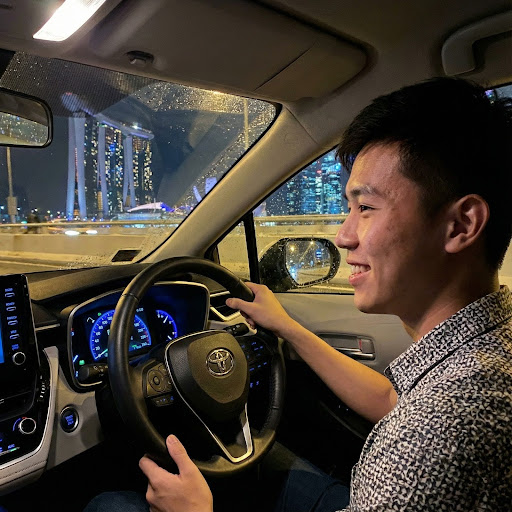
Night driving in Singapore has specific quirks that catch first-time rental drivers off guard. Sudden tropical downpours that cut visibility to 20 metres. Sharp lighting transitions between brightly lit CBD blocks and dark heartland streets. LED headlight glare from newer Japanese and European cars on the CTE. If you’ve just picked up a self drive car rental Singapore for an evening drive, the techniques that work in your home country may not translate directly here.
This guide covers what’s actually different about Singapore night driving, what to check before pulling out of the rental lot, and how to handle the situations that catch rental beginners most.
What Makes Singapore Night Driving Different
Three local conditions shape the experience.
Tropical rain that arrives fast
Singapore gets sudden heavy showers, often without much warning, particularly between November and March. Visibility can drop from clear to severely limited in under 5 minutes. Wipers need to work properly and you need to know where the rear demister switch is before the rain starts.
Sharp lighting contrast between districts
The CBD, Orchard, and Marina Bay are brightly lit. Many residential areas in Pasir Ris, Sembawang, Bukit Timah, and Sentosa Cove have dim street lighting by design. Your eyes need 5 to 7 minutes to adjust each time you transition between bright and dark zones. Plan routes that minimise unnecessary contrast switches.
LED headlight glare
Singapore’s vehicle fleet skews newer than most regional markets, meaning LED and laser-LED headlights are common. These produce noticeably more glare than the halogen lights you might be used to. Adjust your rear-view and side mirrors to the auto-dim setting if available, and avoid staring at oncoming headlights.
Pre-Drive Checks for Your Rental Car
Spend 5 minutes in the rental lot before driving off.
Test all lights
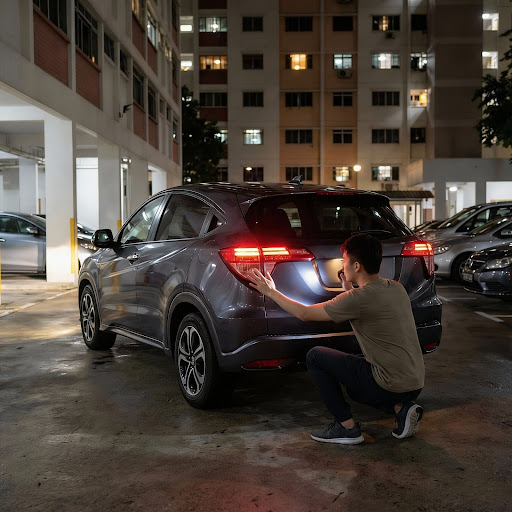
Low beam, high beam, indicators, hazard lights, brake lights, reverse lights, fog lights if equipped. Many rentals have daytime running lights that drivers mistake for full headlights. DRLs don’t illuminate the rear, so confirm you’re using actual headlights after 7 PM.
Clean windows and mirrors
Tropical humidity creates film build-up on glass. Even slightly dirty windscreens scatter oncoming light dramatically at night. Wipe them down before pulling out.
Adjust the mirrors and seat for night vision
Eliminate blind spots by setting side mirrors slightly wider than for daytime driving. Toggle the rear-view mirror to night mode (the small lever underneath flips it from day to anti-glare).
Find the wiper and fog light controls
When tropical rain starts, you don’t want to be hunting for the wiper stalk while doing 70 km/h on the PIE.
Test the GPS
Even if you know Singapore well, GPS audio cues reduce visual distraction at unfamiliar junctions. Mount your phone where it doesn’t block your view of the road.
Larger Rental Vehicles and Night Visibility
Vehicle size changes the visibility calculation more than rental beginners expect.
Compact saloons (Toyota Vios, Honda Jazz) give the easiest night-driving experience for first-time renters. Low driving position, narrow body for tight residential lots, and good rear visibility through standard back windows.
Mid-size sedans and SUVs sit higher with thicker rear pillars that create larger blind spots. Lane changes on the CTE or PIE require more deliberate mirror checks. The higher driving position helps you see further ahead but partially blocks awareness of motorcyclists alongside.
MPVs and 7-seaters carry the biggest visibility tradeoff. The extended rear cargo area, raised seating, and thicker side pillars all reduce rearward and side awareness. If you’re booking an MPV rental with rear parking sensors, this is a feature worth confirming explicitly at booking. Look for vehicles with rear parking sensors, reverse camera, and 360-degree camera systems if available. These features matter most when reversing into narrow HDB parking lots at night, where the boundary between your bumper and the next car can be 30 cm.
Honda Odyssey and similar MPVs commonly include reverse cameras as standard. Confirm sensor functionality during your pre-drive walk-around. Don’t assume features are working just because the dashboard shows them as installed.
Hazards Specific to Singapore Roads at Night
Drivers without headlights.
A surprising number of drivers in Singapore forget to switch on headlights at dusk, particularly older drivers or those used to brightly-lit areas. Watch for vehicles you can only see through their tail-light reflections. Maintain extra distance when you spot one.
Motorcyclists in blind spots.
Singapore has high motorcyclist density on expressways. Lane filtering between cars is technically illegal but common. Check blind spots twice before lane changes, particularly on the AYE, CTE, and SLE.
Cyclists on arterial roads.
Bedok Reservoir Road, East Coast Parkway, and Bukit Batok have active cycling routes. Cyclists may not always have functional rear lights despite the legal requirement.
Pedestrians at hawker centre clusters.
Around food centres in Chinatown, Geylang, Lavender, and Tiong Bahru, pedestrians jaywalk frequently after late dinners. Reduce speed to under 30 km/h in these zones regardless of posted limits.
Wildlife in specific areas.
Wild boars, civet cats, and the occasional monkey appear on roads near Bukit Timah Nature Reserve, MacRitchie, the Botanic Gardens, and Lower Peirce Reservoir Road. Drive with extra caution after 9 PM on these stretches.
Headlight Management Without Causing Glare
Use high beams only on dim stretches of the SLE, KJE, or rural Sentosa Cove roads. Most Singapore arterial roads have enough street lighting that high beams are unnecessary and just blind oncoming traffic.
When you see oncoming headlights, dip immediately. The other driver flashing their lights at you typically means your high beam is on, even if you didn’t mean to leave it on.
Modern Singapore rentals increasingly include automatic high-beam systems that toggle based on detected traffic. These work well on highway driving but can be slow to dim on curved residential roads. Manual override is faster.
For LED glare from oncoming traffic, shift your gaze to the white line at the road’s left edge rather than staring at the road ahead. This keeps you on course without burning out your night vision.
Speed and Following Distances at Night
Drive 10 to 15 km/h below your daytime habit. Reduced visibility means reduced reaction time, regardless of how well-lit the road appears.
Maintain a 4-second following distance in dry conditions and 6-second distance in rain. Count seconds from when the car ahead passes a landmark (lamppost, road marking) until you reach the same point.
On the CTE, PIE, and KPE, expect lighter traffic after 10 PM. The reduced congestion is convenient but tempting people to drive faster. Speed enforcement runs 24/7 with both fixed and mobile cameras. Standard speed limits: 90 km/h on most expressways, 70 km/h on selected stretches, 50 km/h in residential zones.
Weather and Fatigue Considerations
When tropical rain starts
Activate wipers immediately and switch headlights to full (not just running lights). Reduce speed by 20 to 30 percent. Increase following distance to 6 seconds minimum. If rain becomes so heavy that you can’t see lane markings clearly, pull into an MRT station car park or covered HDB lot until it eases. Visibility usually returns within 20 to 40 minutes for typical thunderstorms.
Fog from condensation
Less common in Singapore but happens around reservoir roads and golf courses on cool mornings. Use fog lights (not high beams) and reduce speed.
Fatigue on long drives
If you’re using extended night driving for late-shift work or Malaysia round trips, the cumulative effect is real. Singapore drink-driving laws apply strictly (BAC 0.08% threshold, fines up to S$10,000 for first offence). For long drives, take breaks every 90 minutes. Pull into rest stops at Yong Peng or Senawang if returning from KL late at night.
Singapore Night Driving Rules
Headlights between 7 PM and 7 AM
Mandatory under the Road Traffic Act. Failure to comply can mean fines and demerit points.
Demerit points
Singapore’s points system caps at 12 points for newly-qualified drivers (within first year) and 24 points for experienced drivers. Hitting the limit triggers licence suspension.
Speed enforcement
Fixed cameras at known locations (CTE, PIE, ECP) and mobile camera teams. Fines start at S$130 for minor exceedance and scale up sharply. Major speeding (>40 km/h over limit) can trigger court summons.
ERP charges
Evening peak ERP (typically 5:30-8:00 PM) crosses several CBD gantries. Even after 8 PM, some Friday and Saturday gantries charge for entertainment-zone access. Budget S$5 to S$15 for a typical CBD evening if your route crosses multiple gantries.
Rental insurance specifics
Most rental vehicles in Singapore include 24-hour breakdown support and standard insurance for night incidents. Confirm the emergency hotline at pickup and save it to your phone.
Conclusion
Singapore night driving rewards preparation more than driving skill. Test your lights and wipers before pulling out. Adjust your habits for the local conditions: tropical rain, LED glare, motorcyclists, district-to-district lighting transitions. Size up the visibility tradeoffs of larger rentals before booking.
If you’re new to driving in Singapore and unsure where to start, our company offers rental vehicles across all categories with 24-hour support, breakdown assistance, and Malaysia-extended insurance for cross-border drivers.


