
Self Drive Car Rental Singapore: Requirements & Booking Guide
Singapore Night Driving: Tips for Rental Beginners
January 19, 2026
Car Hire vs Lease Singapore: 3 to 30 Day Costs Compared
April 26, 2026
Self drive car rental in Singapore is simple once your licence, documents and dates line up with what the rental company needs. This blog will walk you through who can rent, which licence rules apply to residents, visitors and expats, how booking works, and what a rental really costs beyond the daily rate.
What Self Drive Car Rental Means in Singapore
Self drive car rental means hiring a car from a rental company and driving it yourself. The car stays registered and insured under the company’s fleet, and you are the authorised driver for the rental period, whether that is one day, one weekend or several months.
It differs from car sharing apps that rent cars by the hour from fixed parking spots, and from chauffeur hire, where a professional driver comes with the car. With self drive, you are responsible for driving within the law, paying ERP and parking, and returning the car in the condition you received it.
Our self drive fleet covers saloons, hatchbacks and stationwagons, larger sedans and SUVs, 7 and 8 seat MPVs, and commercial vans. Which of those you can drive depends on your licence class and on our driver requirements.
Who Can Rent a Self Drive Car in Singapore
Our Driver Requirements
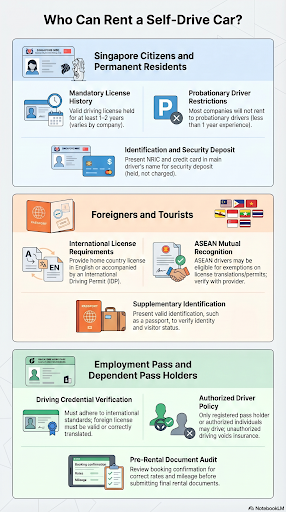
The hirer and any additional driver must be at least 24 years old, hold a valid Singapore Class 3 or approved foreign licence, and have at least two years of driving experience. That two year rule means drivers still on a probationary licence cannot rent from us. Every person who will drive the car must meet the same conditions, so name all drivers when you book.
Singapore Licence Classes and What They Cover
Singapore’s licence classes decide what you can legally drive. According to the Singapore Police Force driving licence guide, a Class 3 licence covers motor cars up to 3,000kg unladen with no more than seven passengers plus the driver, along with light goods vehicles. Class 3A covers the same vehicles without a clutch pedal, so it is automatic only.
Class 3C and 3CA are car only licences. They cover the same motor cars as Class 3 and 3A but not vans or other light goods vehicles. Every car and MPV in our fleet, the eight seat Hyundai Trajet included, falls within the seven passenger limit, so all of these classes cover them legally. If you hold a 3C or 3CA licence, mention it when you book. To rent a commercial van, you need a Class 3 or 3A licence.
Tourists and Short Stay Visitors
Foreigners residing in Singapore for less than 12 months can drive on a valid foreign licence. The Singapore Police Force requires them to carry an International Driving Permit issued by an authorised body in their country of origin, or an official English translation of the licence if an IDP is not available. Visitors holding a licence from an ASEAN member state do not need an IDP.
Get the IDP before you leave home. The Automobile Association of Singapore issues IDPs only to Singapore licence holders driving overseas, so a visitor cannot apply for one after landing. An IDP is a translation of your licence and is not valid on its own, so carry both documents together. Our guide on who needs an IDP for car rentals covers the details by country, and our car rental guide for tourists covers collection and driving tips for first time visitors.

Expats and Pass Holders Staying Longer
Foreigners residing in Singapore for more than 12 months must convert their licence to a Singapore one. The Singapore Police Force sets two criteria for conversion: pass the Basic Theory Test in Singapore and hold a valid foreign licence. A successful conversion gives a Class 3C licence, which covers cars. Driving Class 3 vehicles such as vans needs a practical driving test on top of the Basic Theory Test.
If you are on an Employment Pass or Dependant’s Pass and plan to rent for longer than a year, start the conversion early so there is no gap in your ability to drive.
Documents and Payment at Collection
Bring these to collection:
- Singapore residents: your NRIC and a valid Singapore driving licence.
- Visitors: your passport, valid foreign licence and IDP or official English translation, unless your licence is from an ASEAN country.
- Long stay pass holders: your pass, and your converted Singapore licence once you pass the 12 month mark.
A refundable deposit of S200appliestoeveryrental.TheS200 reservation deposit is not refunded if you cancel or do not show up. Payment is made by cash, PayNow, PayLah! or bank transfer when the car is delivered, and corporate customers can also pay by cheque.
How to Book a Self Drive Car
Step 1: Choose Your Dates
Our rentals are charged by the day. The minimum hire is one day on weekdays and two days for the weekend package. Weekly and monthly bookings bring the daily rate down.
Step 2: Choose the Vehicle Category
Match the car to your passengers and luggage. A saloon such as the Toyota Vios or Corolla Altis, or a hatchback such as the Honda Fit, suits one to four people and starts from S70perday.AfiveseatSUVsuchastheHondaCR-VstartsfromS120 per day and suits families with prams or heavy luggage.
For six or more passengers, you need an MPV. Our 7 seater car hire in Singapore starts from S$120 per day, with the Toyota Sienta, Honda Odyssey, Toyota Estima and Toyota Alphard, plus the eight seat Hyundai Trajet. Our guide to the best car for short term rental compares each category by seats, luggage and parking.
The Mercedes-Benz E250, Mercedes S-Class and BMW 523i in our fleet are not available for self drive on short bookings. They are offered on long term rental or with a chauffeur only.
Step 3: Confirm Malaysia Use If You Need It
Our saloons and MPVs can be driven into Malaysia as far as Kuala Lumpur, with a cross border surcharge from S$50 per day that extends the insurance. There is no mileage limit for Malaysia use. Tell us at booking so the car is cleared for the trip, and read our car rental to Malaysia page for the VEP, road charge and fuel rules.
Step 4: Arrange Delivery or Self Pickup
Delivery and collection are free from 9am to 5pm on weekdays and 9am to 2pm on Saturdays, with at least one to two hours’ notice. We deliver to your home, hotel, office or Changi Airport. A surcharge applies outside those hours and on Sundays and public holidays. Self pickup is at our Kovan Hub office, 206 Hougang Street 21, near Kovan MRT.
Step 5: Inspect the Car at Handover
Walk around the car with our staff, photograph existing scratches or dents, and note the fuel level. Our rental car collection checklist lists what to check inside and out so there are no disputes at return.
Choosing a Rental Duration
For a day, a weekend or a few weeks, short term car rental is the standard fit. Daily rates start from S70forasaloonorhatchbackandS120 for an SUV or MPV. This covers visitors, weekend trips, workshop replacements and short projects.
Monthly bookings lower the daily cost further. On a monthly rate, compact cars and stationwagons start from S50perday,fullsizecarsandSUVsfromS60, and MPVs from S65.Acompactcarfor30daysworksouttoaboutS1,500, with insurance and road tax still included. Monthly rental suits expats settling in, residents between cars and assignments of one to three months.
For a year or more, a long term lease brings the lowest effective cost and replaces most of what ownership offers, without the COE outlay. Ask our team for lease terms on 12, 24 or 36 month contracts.
Self Drive Rental Versus the Alternatives
Versus Ride Hailing
Grab and taxis suit one or two trips a day. Once the day involves several stops, early mornings, late returns or a group that does not fit in one car, a rental from S$70 per day gives you predictable costs and no waiting between trips.
Versus Owning a Car
The Certificate of Entitlement, or COE, is the ten year right to own a car in Singapore. Category A closed at S$133,009 in the first September 2026 exercise, according to Motorist’s COE results report. That is about S$1,108 a month for the COE alone, before the car, insurance, road tax, parking or servicing. If you drive a few days a week or less, renting when you need a car costs less.
Versus a Chauffeur
Our chauffeur service makes sense for airport transfers, corporate events and trips where you want to work or rest in the back. For errands, school runs and family weekends, self drive keeps the route and timing in your hands without paying for a driver’s time.
Costs Beyond the Daily Rate
Every rental includes insurance, road tax, unlimited mileage, breakdown service and full maintenance. You pay for the following on top:
- Petrol. Return the car at the fuel level you received it, or an estimated refuelling charge applies.
- ERP. Charges apply from Monday to Saturday, with no ERP on Sundays or public holidays.
- Parking at HDB, mall and CBD car parks.
- Traffic and parking offences committed during the rental.
- The Malaysia surcharge from S$50 per day, plus the RM20 road charge per entry and RON97 petrol once you cross.
Mistakes First Time Renters Make
Skipping the handover inspection is the most avoidable one. Without photos of existing damage, it is hard to show a scratch was already there.
Letting someone else drive is the second. Only drivers named on the agreement, each meeting the age, licence and experience rules, may drive the car.
Visitors often arrive without an IDP. It must come from the country that issued your licence, so it cannot be arranged after you land.
Booking a Sunday return without checking delivery hours adds a surcharge you could have avoided by returning on Saturday before 2pm or dropping the car at Kovan Hub.
Cancelling late costs the S$200 reservation deposit, so confirm your dates before you book.
When you are ready to compare cars, see our full fleet and pricing, or call +65 6858 0166 or WhatsApp +65 9690 2887.
FAQs About Self Drive Car Rental
Can I rent a self drive car in Singapore with a foreign licence?
Yes, if you are staying under 12 months. Singapore Police Force rules require an International Driving Permit from your home country, or an official English translation if no IDP is available. ASEAN licence holders do not need an IDP. You also need two years of driving experience and must be at least 24.
What is the minimum age to rent a self drive car?
At Singapore Car Rental, every driver must be at least 24 years old with at least two years of driving experience. That rules out drivers on a probationary licence. The same conditions apply to any additional driver named on the rental agreement.
How much does self drive car rental cost per day in Singapore?
Saloons and hatchbacks start from S70perday,andSUVsandMPVsfromS120. Monthly rates start from S50perdayforacompactcarandS65 for an MPV. Every rate includes insurance, road tax, unlimited mileage, breakdown service and maintenance.
Can I rent a car or van with a Class 3C licence?
A Class 3C or 3CA licence covers cars and MPVs with up to seven passengers plus the driver, which includes every car and MPV in our fleet. It does not cover vans or light goods vehicles, which need Class 3 or 3A. Mention a 3C licence when you book.
Can I drive a self drive rental car to Malaysia?
Yes. Our saloons and MPVs can be driven into Malaysia as far as Kuala Lumpur, with a cross border surcharge from S$50 per day and no mileage limit. Tell us at booking, and budget for the RM20 road charge per entry and RON97 petrol.
What documents do I need to rent a car as a Singaporean?
Your NRIC and a valid Singapore Class 3 or 3A driving licence. A refundable S$200 deposit applies, and payment is by cash, PayNow, PayLah! or bank transfer on delivery. Every driver must be at least 24 with two years of driving experience.
Is there a deposit for self drive car rental?
Yes. A refundable S200depositappliestoeveryrental.TheseparateS200 reservation deposit is not refunded if you cancel or do not show up, so confirm your dates before booking.


