
ERP & Parking Fees: Budgeting for Rental Cars
Child Seat Car Rentals Singapore: Rules & Prices
January 15, 2026IDP for Car Rentals: Who Needs It?
January 15, 2026ERP and parking are the two costs most rental drivers underestimate when budgeting for Singapore. A typical CBD driving day adds S$15 to S$35 in these charges on top of the rental rate and fuel. Heavy CBD use over a 5-day rental can push the total over S$150. Most of this is avoidable with timing changes, route adjustments, and parking choice. This guide covers the actual rate structures, the avoidance strategies, and how to budget realistically.
How ERP Actually Works for Rental Cars
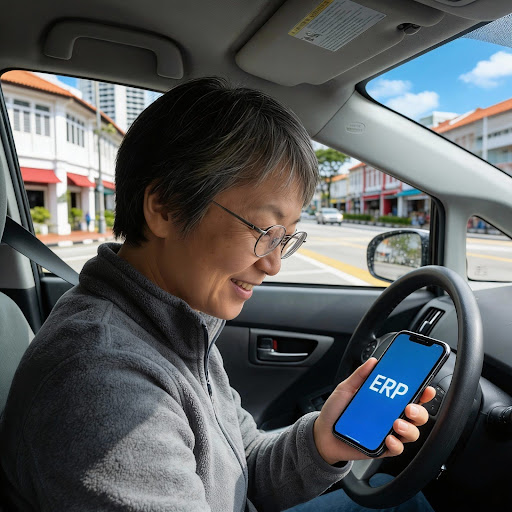
ERP stands for Electronic Road Pricing. Gantries on selected expressways and arterial roads automatically deduct charges from the vehicle’s In-Vehicle Unit (IU) using a CashCard or NETS FlashPay card. Rental cars come with the IU pre-installed and a CashCard already inserted.
How charges accumulate
Each gantry has its own rate that varies by time of day, in 30-minute blocks. A single CBD trip through the morning peak might cross 3 to 5 gantries with charges from S$0.50 to S$6 each. The total adds up quickly if you’re crossing multiple priced zones.
Rates by location and time
- Peak expressway gantries (CTE, PIE, KPE, AYE near CBD). S$2 to S$6 during peak windows (7:30 AM to 9:30 AM weekdays, 5:30 PM to 7:30 PM weekdays). S$0 to S$2 outside these windows.
- CBD cordon gantries (Orchard, Marina Bay, CBD core). S$0.50 to S$3 during chargeable hours, typically 7:30 AM to 8 PM weekdays.
- Arterial gantries (Bukit Timah Road, Bukit Merah, Toa Payoh). Lower rates, often S$0.50 to S$2 during chargeable hours.
When ERP doesn’t charge
- Sundays
- Singapore public holidays
- Eves of major public holidays (Chinese New Year, Hari Raya, Deepavali, Christmas) — operations typically stop at 1 PM
- Outside the gantry’s chargeable hours
Current rate transition
LTA has been rolling out the next-generation OBU (On-Board Unit) system from late 2023 onward. By 2026, many vehicles are on the new GPS-based satellite system, while older vehicles continue using the IU and CashCard. For rental purposes the experience is largely the same: charges deduct automatically as you drive.

How Parking Works in Singapore
Singapore parking spans three main systems:
HDB and URA short-term car parks
Pay via Parking.sg app or self-service kiosks. Per-half-hour pricing: S$0.60 to S$1.20 weekdays, S$0.60 to S$1.20 weekends in residential areas. Central area rates roughly double these.
Electronic Parking System (EPS) car parks
Used at shopping malls, office towers, and commercial buildings. Per-minute or per-hour billing, paid at exit gates with CashCard or NETS FlashPay. Rates vary widely from S$1 to S$5 per hour depending on location.
Coupon parking
Older system still in use at some street parking and smaller car parks. Paper coupons sold at convenience stores and tear-off based on time used. Cost S$0.60 to S$1.20 per half-hour.
Daily caps
Many commercial car parks impose daily maximums (S$15 to S$40) which become attractive for full-day visits to the CBD or shopping districts.
Daily and Weekly Rental Cost Picture
A realistic budget for ERP and parking on a Singapore short term car rental in Singapore depends heavily on how often you enter the CBD and during which hours.
Light usage (suburban-only driving)
- ERP: S$0 to S$5 per day (often zero if you stay out of the CBD)
- Parking: S$5 to S$15 per day (HDB and suburban malls)
- Total: S$5 to S$20 per day
Mixed usage (1 to 2 CBD trips per day, mostly off-peak)
- ERP: S$5 to S$15 per day
- Parking: S$10 to S$25 per day
- Total: S$15 to S$40 per day
Heavy CBD usage (peak hour commutes plus mall parking)
- ERP: S$15 to S$30 per day
- Parking: S$25 to S$50 per day
- Total: S$40 to S$80 per day
For a 5-day rental in the heavy usage pattern, ERP and parking can add S$200 to S$400 on top of the base rental rate. Light usage might total under S$50 for the same period.
Before booking a self drive car rental in Singapore, factor these charges into your total daily cost estimate. The base rental rate is rarely the full picture.
Free parking alternatives.
Many shopping malls offer 1 to 2 hours of complimentary parking with a minimum spend (often S$30 to S$50 at participating tenants). HDB car parks are free on Sundays at many locations. Check signage at each car park as policies vary.
Strategies for Reducing ERP Costs
Travel outside peak windows
Most CBD-bound ERP charges sit between 7:30 AM and 9:30 AM and again between 5:30 PM and 7:30 PM. A trip starting at 9:45 AM may pay zero or near-zero ERP for the same route that would cost S$10 to S$20 at 8 AM.
Use surface roads parallel to expressways
The CTE has surface alternatives (Whitley Road, Lornie Road). The PIE has alternatives (Eunos Link, Bedok Road, Upper Serangoon Road). These cost zero but add 10 to 25 minutes depending on the route.
Plan multi-stop trips during off-peak windows
Bundle errands into a single 11 AM to 4 PM block instead of separate trips at 9 AM and 6 PM. Both peak windows avoided.
Use the OneMotoring app
LTA’s official app shows real-time gantry rates. Useful for last-minute route decisions when you’re unsure whether a specific gantry is currently charging.
Sundays and public holidays
No ERP. Plan CBD visits for these days if your itinerary allows.
Strategies for Reducing Parking Costs
Park outside the CBD and take MRT
Marina South Pier, Tanah Merah, or Buona Vista car parks (with MRT connections) cost S$2 to S$8 per hour vs S$5 to S$15 in the CBD core. A 5-stop MRT round trip costs roughly S$3 for two adults.
HDB car parks for evening events
Most HDB parks charge S$1 to S$2 for an evening visit (after 5 PM until 7 AM). Significantly cheaper than commercial alternatives.
Use Parking.sg properly
The app lets you pay exact time, extend remotely, and avoid overstay fines. Photograph the parking signage so you have evidence if a dispute arises.
Look for malls with parking validations
Plaza Singapura, ION Orchard, VivoCity, and others offer free parking with minimum spending at restaurants or supermarkets. If you’re shopping anyway, the validation saves S$10 to S$20.
Avoid parking fines
Standard fines start at S$30 to S$50 for short overstays, escalating to S$200 to S$300 for parking in restricted zones. Rental companies pass these fines through with administrative fees of S$25 to S$50 on top. A S$50 fine becomes S$75 to S$100 by the time it hits your credit card.
Rental-Specific Considerations
Driving licence requirements
English-language licence holders (US, UK, Australia, New Zealand, Canada, etc) and ASEAN country licence holders generally do not need an International Driving Permit for Singapore driving under 12 months. Non-English licence holders typically need either an IDP or a certified English translation.
CashCard top-up
Rental companies usually start the rental with a CashCard pre-loaded (typically S$30 to S$50). For longer rentals or heavy CBD use, top up at any 7-Eleven, Cheers, or SAM kiosk to avoid an insufficient balance trigger. Insufficient balance at a gantry generates a S$10 administrative fee on top of the original ERP charge.
Return with zero outstanding charges
Some rental companies impose handling fees if the vehicle returns with unpaid ERP or parking violations. Check the OneMotoring app for outstanding charges 1 to 2 days before return and settle directly if possible.
Long-term and frequent users
If your stay is over 2 months, a long-term lease arrangement bundles many of these administrative concerns into a single monthly bill. Standard rental rates for short-term use include the IU and CashCard but bill ERP and parking as pass-through costs.
Weekly Budget Worksheet
For a tourist or short-term visitor doing a typical Singapore exploration week:
| Activity Pattern | ERP/Week | Parking/Week | Total |
| Mostly local sights, off-peak driving | S$0 to S$25 | S$30 to S$70 | S$30 to S$95 |
| Mixed CBD and suburban, some peak driving | S$25 to S$75 | S$60 to S$150 | S$85 to S$225 |
| Daily peak-hour CBD commuting | S$75 to S$150 | S$125 to S$250 | S$200 to S$400 |
Plus fuel
Singapore fuel runs roughly S$3.00 to S$3.30 per litre for RON95 in 2026. Most rental cars consume 6 to 9 litres per 100 km for sedans, 9 to 12 litres per 100 km for SUVs and MPVs.
Conclusion
Singapore ERP and parking charges add up, but they’re highly avoidable with timing and route choice. The most consistent saving strategy is to keep CBD trips off the morning and evening peak windows. The second is to park strategically ,outside the CBD with MRT for final-leg, or with mall validation for shopping trips.
For visitors, building S$15 to S$40 per day into your rental budget for ERP and parking covers most realistic usage patterns. Heavy CBD users should plan for S$40 to S$80 per day. Both estimates assume basic strategy use; without route planning, the totals run noticeably higher.